My last post on Strategy and Change sparked some interesting commentary on the topic of “how much change and how fast?” and got me thinking about optimizing the balance of Change and Continuity in an organization. Expressing it as a ratio is a logical follow-on. With that idea rattling around in my mind, I read this article about what’s happening at Meta (formerly Facebook) and how the changes have caused “internal disruption and uncertainty.” (And that was before their most recent quarterly earnings report.) Can’t imagine a much bigger Change-Continuity Ratio (CCR) than that!
Obviously, both elements of the ratio have value. Continuity provides stability and predictability that make employees feel safe and sure-footed in performing their jobs. Customers tend to favor it as well. Change is often (usually/always) less popular with employees, but necessary for the ongoing viability of the organization.
Both also present risks. Continuity risks stagnation and disengagement, particularly with ambitious team members. And change risks fear and even paranoia as employees struggle to see their places in an emerging organization.
How to keep the CCR in a reasonable balance?
First, I think it’s essential to acknowledge that you have limited control on factors outside of your organization that can affect perceptions of the CCR. If your company is under existential threat from a disruptive competitor, the ratio is going to way up, out of necessity. Similarly, if the market isn’t ready to adopt your visionary new product, then the Continuity denominator way remain uncomfortably large. Given external factors, you may be forced to change the internal dials on Change and Continuity away from your preferred settings.
Second, it’s important to recognize the different roles in change leadership in the organization, and what that means for CCR “sub-cultures.” Executives must define and lead change. They should live in a world where the CCR is very high — intentionally. This is a growth opportunity for many new executives who are more comfortable with a CCR below 1, based on their success in functional management.
At the other end of the spectrum, and without sounding paternalistic or minimizing opportunities for daily innovation or continuous improvement, it’s generally better for those delivering today’s value proposition to customers and partners to have as much continuity as possible. Incremental changes, introduced regularly and with advance notice and proper context, can lead almost imperceptibly to significant change over time…assuming you have that luxury.
The two ends of the spectrum described above are fairly straight-forward, but this leaves the management tier in a familiarly awkward position, straddling the executive and line-level operational roles. Managers should experience a much more balanced CCR as they collaborate both up and down in the organization.
Managers play an important role in implementing Change and providing localized context to help their teams understand and embrace change. They’re also important in ensuring current year performance and providing feedback on day-to-day operations, which are tied more closely to Continuity. Clarifying expectations with managers on striking this balance, with a CCR of 1, is critical to their effectiveness.
The slide below summarizes these ideas on CCR sub-cultures:
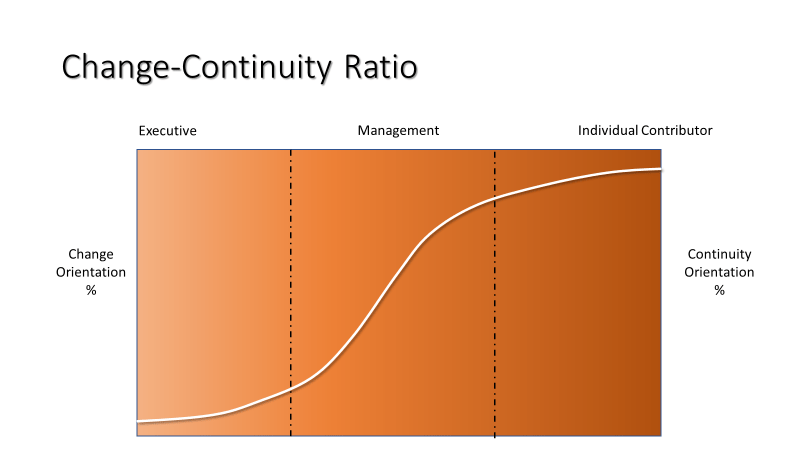
The point here is to be intentional about the Change-Continuity Ratios in your organization. Defining expectations and providing feedback are so critical in making sure your organization is both delivering today’s performance and moving toward its future.
How do you see Change and Continuity in your organization? How would you characterize your Change-Continuity Ratio? Leave a comment!
 Strategy, Creativity, and Leadership