Welcome to January 2023! Most of us operating on calendar year schedules have a new set of annual performance objectives and a budget with approved resources to deploy. Let’s get busy!
But what sort of organizational view do we have beyond the current year? And why does such a view matter?
Most companies have some combination of mission/vision/purpose statements that express the business’s ultimate reason for being. These can be both explanatory and inspiring as they often express a general value proposition and the aspiration for a substantially improved existence for their customers and other stakeholders.
And yet, making connections between this year’s work and the company mission without some sort of “middleware” can be very difficult. After all, the two are expressed at very different levels of abstraction and in very different time frames. In fact, most mission/vision/purpose statements I have seen are timeless in nature and certainly don’t state a specific timeline for realizing them. So how can we gauge 2023 performance in terms of “progress toward our mission”?
The gap or lack of connectivity between this year’s operating plan and the higher-level statements can create misalignment, uncertainty, and unnecessary risk in the organization. Functional groups go about executing the 2023 plan without sufficient context or guidance on collaboration and prioritization. Decisions can be made with too much emphasis on short-term benefits, without an understanding of medium- and long-term impacts. These can come from virtually any part of the organization, from signing on non-strategic new customers, hiring or retaining employees for expediency, or neglecting strategic initiatives with key partners/suppliers.
Some leaders may believe that line-level employees and even middle management don’t need anything more than a current operating plan. “That’s all they’re working on anyway. Anything else is a distraction.” But a simple focus on making this year’s numbers, without some understanding of a grander organizational plan, is short-sighted and can blindly jeopardize longer-term success.
So what is it that “fills the gap” between this year’s work and the company mission? I call it a Corporate Narrative, and it offers the following benefits to the organization:
- It puts current operations in the context of a medium-term (3-4 year) “era” in the company’s progress toward its mission. In its form as narrative, it explains both the challenges and opportunities the company expects to encounter and the unique capabilities it will use to flourish in the years ahead.
- It describes a set of 3-5 strategic change initiatives that will result in the closure of the era and materially higher levels and/or areas of performance. These multi-year change initiatives are apparent in the current year operating plan, with defined milestones and resources.
- It provides a singular voice of leadership intent for all members of the executive team to leverage both as a team and as individuals.
- It provides an ongoing mechanism for communicating about progress through the era, and for making adjustments that may be appropriate due to changing circumstances.
- On the whole, it provides higher levels of confidence and trust for critical stakeholders, especially in times of volatility, uncertainty, complexity, and ambiguity (like 2023).
The Corporate Narrative is developed as part of a collaborative exercise among executive team members. In many cases, the team can leverage existing strategic artifacts, though these may require updating or editing for coherence across a range of information. Bringing all the strategic elements into a unified, credible, and inspiring corporate narrative that leadership can use to drive change is the ultimate goal of the exercise. This is what connects the annual operating plan to the company’s mission.
I studiously avoid two words in describing, developing, and executing around a Corporate Narrative. The first is strategy, which I believe has been over-used, has too much baggage, and in any case has more of a “technical” feel than a narrative. This doesn’t mean that the Corporate Narrative doesn’t contain strategy, but I don’t name it that for leadership purposes. The second word I avoid is story. In recent years, much has been written about the value of story-telling in business. However, the word has connotations around fiction that are not helpful in a business context, whereas narrative has explanatory overtones that I believe are important in building stakeholdership.
There isn’t just one way to create a Corporate Narrative, or one way to put it into motion for your business, but let’s get back to the purpose behind it and think about what might serve that purpose most effectively. The Narrative is a powerful leadership tool that can
- Connect today’s activity to longer-term success in concrete and time-bound ways, complementing mission/vision/purpose statements
- Rationalize the changes that are necessary for the business to move forward and connect these to resource allocation decisions in the current operating cycle
- Focus attention on the company’s most important assets and capabilities, and how they will be evolving in future periods
- Establish a framework for measuring and communicating corporate performance to all stakeholders, balancing quantitative and qualitative information
- Unify the voice of the executive team and empower individual leaders within their areas of responsibility and authority
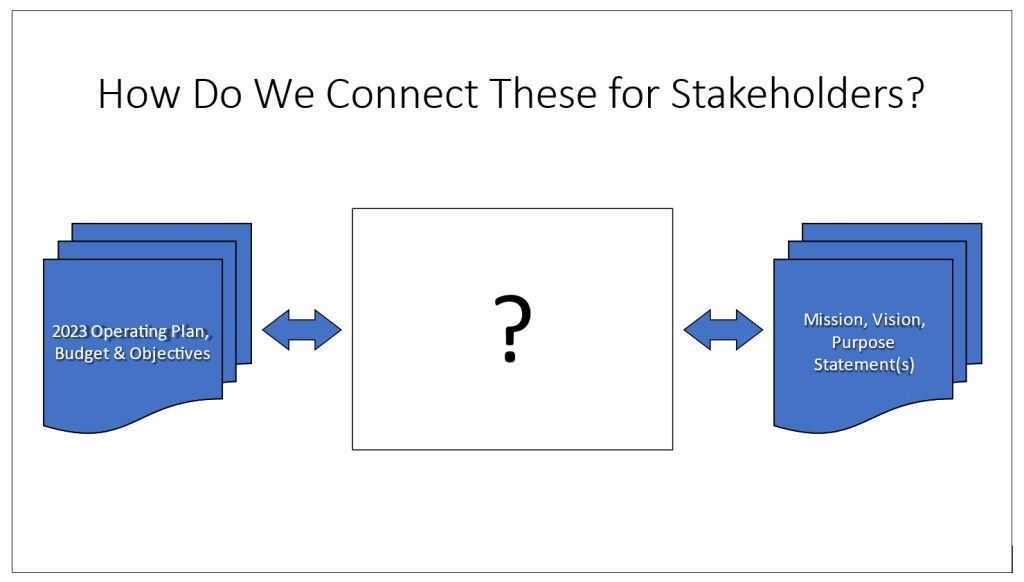
If you agree that these are worthwhile leadership outcomes, then you can begin to assess how – and how effectively – they are happening in your organization today, for various stakeholders. As a starting point, complete the exercise below: how would you answer the question, and what would you put in the empty box between the 2023 documents and the mission/vision/purpose statements?
You’ll probably note that the degree of connectivity varies among your stakeholder groups. Investors and board members tend to be quite demanding about making the connections explicit, at least during closed-door meetings. What about middle managers and employees? Onboarding and transitioning managers and employees? Customers and partners? How evident, credible, and consistent is the linkage?
This is not to say that all these groups receive the exact same level of detail, frequency, repetition, etc. when it comes to a Corporate Narrative. But all of leadership’s “strategic communications” with these groups will be based on the core Narrative and generally consistent with each other.
I’ve facilitated the creation and implementation of a Corporate Narrative on multiple occasions, and with many organizations. It leads to stronger, more unified leadership teams and more effective, purposeful business operations. This is what I put in the box in the middle of the diagram, and what I see as an essential act of leadership.
I’ll invite you to share how you make these connections in your organization. What successes and challenges have you experienced? What would you add to my thoughts above? Hope to speak with you soon.
 Strategy, Creativity, and Leadership